Showing posts with label teaching. Show all posts

Thursday, January 31, 2008

Teaching

Working with teenagers is what I like to do, and what I'm good at. Sometimes it totally frustrates me, though. Like last night.

There's this extracurricular activity that another teacher and I lead. We've done it for a few years now, and some of the girls involved in it have become friends. Well, I don't know if that is the right word, because there's a twelve year age difference between us and obviously we don't confide in them. They do confide in us, though. Last night one of the girls told my colleague something that broke my heart. She told her that she had a problem involving auto-mutilation, and even showed her arm.

I thought I knew this girl. I thought she was a happy, bouncy teenager whose only problems could be what time to get home after a party or what clothes to wear. But I was wrong.

There's nothing I can do for this girl. I don't even teach at her building. Thank goodness she told my colleague that she had been talking to the school's counselor, so she is getting help. But I feel slightly powerless. Sure, I can pray for her and be nice to her. But somehow that doesn't feel like it's enough.

Getting attached to your students is a good thing, but it also has its downside...

Thursday, October 04, 2007

What doesn't kill you...

... Makes you stronger. Isn't that a famous expression? I'm going through one of those times at work at the moment. One of the other teachers (who shares a room with me) called me last week and accused me of all kinds of horrible things. I block her progress, I say no to everything she wants to change, I can't think outside of the box. In short, I'm a horrible person at work and there's no fun working with me.

It totally made me think, and shocked me too. Am I really that narrow-minded? Do I really get scared when things go differently? After a lot of thinking and talking to different people, I realised that I do say "no" to a lot of things she wants to implement. But only because they're against school or music department rules or agreements. And maybe I sometimes try to stop her, because I know ahead of the time that the thing she wants to try won't work. I've shared lots of lesson plans and work sheets that I've made with her, thinking that she would appreciate not having to make them herself. But she accused me of trying to make her into a copy of myself, teaching wise! I was baffled. Here I was, trying to be nice, and she totally used it against me! That taught me a lesson. I won't share things with her any longer.

Last week I sent her an e-mail, inviting her to stay a little longer on Monday and talk to me about this situation. She did not reply, but Monday she had called in sick. Of course, there is a flu going around. But it did seem like an awful coincidence in my narrow-minded suspicious mind.

Thursday, August 23, 2007

Mentor

Because I'm graduated and work four days a week now, my school asked me if I wanted to become a mentor. Dutch people know what this is, but for Americans it's something mid-way between a home-room teacher, a guidance counselor and an elementary teacher. Every class of 20-30 kids (I only have 18) has their own mentor. The mentor is the person who monitors their grades and who they can talk to if something is wrong, or if they just need some attention. The mentor is also the person the parents contact when they want to contact school for questions or remarks.I teach my class music, Dutch and study skills, so I see them 9 times a week.The school year is only three days old but already being a mentor gives a whole new dimension to my teacherhood. (Is that a word? It is now.)

My mentor group is a class of first year students (7th graders, for the Americans). Everything is new to them in our school, and most of them don't know any other kids in their class yet. So it's up to me to make them comfortable with each other. I'm really going to try and make them bond, because I want the atmosphere in the class to be as positive as possible, so that when they're settled in and the hormones start acting up there's already a good relationship between the kids.

Yesterday I taught "my" kids 7th period, which was their last period of their very first day of high school. They were so enthusiastic! They told me about how they walked to the gym and it started to rain, how the math teacher's glasses were crooked and how their German teacher told them they would start working when the class didn't have any more questions for him, so they chatted with him all 50 minutes.I think they're cute. And they're my kids!

I sincerely hope they stay this upbeat and happy...

Wednesday, March 21, 2007

Boy/girl

Even though I sometimes consider myself a pretty experienced teacher (is that ok after 3 1/2 years?) something happened a few weeks ago that I had never seen before, and won't easily forget.

In one of my wonderful second year groups, one of the girls announced that she is no longer a girl, but wants to be a boy. She had had thoughts about becoming a boy ever since she was seven years old (she now is 14) and had made the decision to change her name and appearance.
I had already heard some gossip about this, but decided not to pay too much attention to it. After all, if it was true, her mentor would inform me. And so she did. Two weeks ago we were informed that Anna (name changed of course) was to change her name to William. The teachers were asked to call her that and pay attention to her (or his?) wish to be approached as a boy. So no more "Hurry up young lady, get your book and start to work!" but rather: "Hurry up, get your book and start to work!".

Even though this situation seems weird, I'm already used to it. The kids in her class are handling this wonderfully and this has really calmed her down. Her behavior had been going through the roof lately, right before she made her announcement. Thank goodness she's in a wonderful class (I know I already said this but I love them). Any other second year group would have picked on her horribly. Not this group. They say things like: "Hey Billy, come on!", "Look Miss M, this is my brother" (for some reason 13 year olds like refer to each other as siblings when they get along well).

Isn't this an interesting situation?

Wednesday, March 14, 2007

My week

In the past week:
- the weather was awesome;
- we finalized our mortgage;
- I went from teaching 9 hours a week to teaching 12 hours (almost back at my regular 15);
- we spent the week-end to my grandpa's who lives by the North Sea, because he turned 94;
- I graded lots of papers;
- I took some more walks by the river and took some more pictures of the high water level;
- I worked in the garden for the first time this year (and how lovely it was to be outside again);
- I did lots of laundry (which was all dried outside, oh how I love the smell of air-dried clothes);
- I actually cleaned my house (hadn't been done in too long).

I'm sure you will now understand why I haven't been online much! I've been doing so many things, while trying to keep in mind that I'm still sick and need to rest. So I've also carefully scheduled nap times and reading times, which works well for me.
Spring is in the air and I love it!

Wednesday, February 14, 2007

Work, study and vacation

You may have noticed that my blogging frequency has gone down. That's a good sign: it means that I am spending more time on work and study.

I went back to teaching Dutch to a group of eigth graders of the lowest level (vmbo). It definitely costs a lot of energy, because it's a really noisy group. But they're nice kids and we'll get used to each other quickly I'm sure.Next week we have our spring break and M and I are going skiing in the Italian Dolomites (Southern part of the Alps), together with lots of family members. We're really looking forward to that! I'm sure that some outdoor exercise, combined with amazing Italian food will do me good. I hope to look better than I did last year. But if it snows like it did last year, I'll look just like this again! :)
I've also picked up my studying again. I'm working on my thesis. The main question I'm trying to answer is: "What extra skills does a music teacher in vmbo need, as opposed to a music teacher in havo/vwo?". (click here for an explanation of vmbo/havo/vwo) The reason for that is that I seem to be the only person who enjoys to work with the lowest level kids. Most graduated music teachers start in job like that, but move up to higher levels as soon as they get the chance. I think that is because they weren't properly prepared in college. That's why I will be teaching a group of third year college students, as a part of the practical part of my thesis. And the dean has so much faith in me that the students that take my class will actually be awarded credits, how cool is that?

All in all, I'm back to a busy life. Although I must say that the study discipline I used to have, isn't really back yet. Take now, for instance. I went to the computer to start typing on my thesis (I already have 2 pages) and now I'm blogging again...

Saturday, November 18, 2006

School system


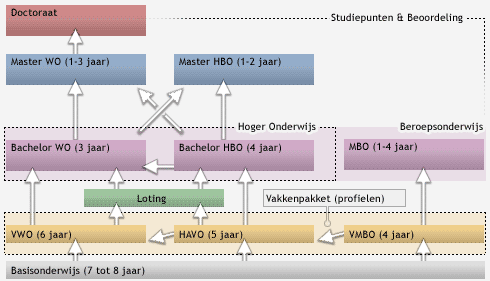
Many people from abroad ask me how the Dutch school system works. Many people from the Netherlands do as well, because not too long ago many things have changed. That's why I'll attempt to explain everything. I found a diagram on the internet that might help clarify things a little. It's in Dutch though, but that doesn't matter because I'll use the abbreviations for the directions in my English explanation as well.

In the Netherlands children usually start going to school when they're four years old. The first two years of elementary school (group 1 and group 2) are comparable to the American and German kindergarten. The children spend most of their time playing in educational centers and corners, learning all kinds of skills that are necessary for when they start going to what Americans would call "first grade", but we call "group 3". This is the group where they start learning to read and write and do math and such. After this, things are pretty much comparable to the American elementary school, until the end of group 8 (American sixth grade). All children take a test, called the Cito test. The results of this exam, combined with the teacher's advice, decides to which type of school the kids will go after elementary.

In my country middle school and high school are one. There are three types: VWO, HAVO and VMBO. I'll generalize a little to makes things easier to understand.


  • VWO (Voortgezet Wetenschappelijk Onderwijs or Higher Scientific Education) is for the most intelligent children. It's a six year school whose diploma qualifies for medical school, law school, and other types of higher university.

  • HAVO stands for Hoger Algemeen Voortgezet Onderwijs, which translates into Higher General Secondary Education. After five years of HAVO you can go to HBO (Hoger BeroepsOnderwijs, or Higher Vocational Education). You go to HBO if you want to be a teacher, nurse, engineer, social worker, controller, finance specialist, there are all kinds of things possible.

  • VMBO is Voorbereidend Middelbaar BeroepsOnderwijs. This means Preparing Middle Vocational Education. The kids in this type of school are the ones I teach. It's the lowest level of school, and very practically oriented. It only takes four years, so you graduate when you're 16/17.
    The kids I teach are the future plumbers, construction workers, beauticians, assistant nurses and waiters of the Netherlands. It's a four year school, where the kids do a lot. They don't spend a lot of time learning from books, but they learn by doing. If you walk around our school you can see kids cooking, building brick walls, welding and washing each other's hair.

As you can see in the image, it's possible to "move up". If you've taken the highest level of VMBO (which is subdivided into 4 levels, but I'll explain about that later) you can obtain a HAVO-diploma by going to school for two more years. The same works if you have a HAVO-diploma and want to continue on to VWO.
Complicated, isn't it? I think it works well though. We have a way lower drop-out rate than many other countries. The practical people don't have to worry about books, and the book people don't have to worry about to much "doing". Almost everybody has a place where their intelligence fits in. And that's the most important thing.